Vertical Termination Height Calculator (AS 4654.2)
Calculate the required upstand
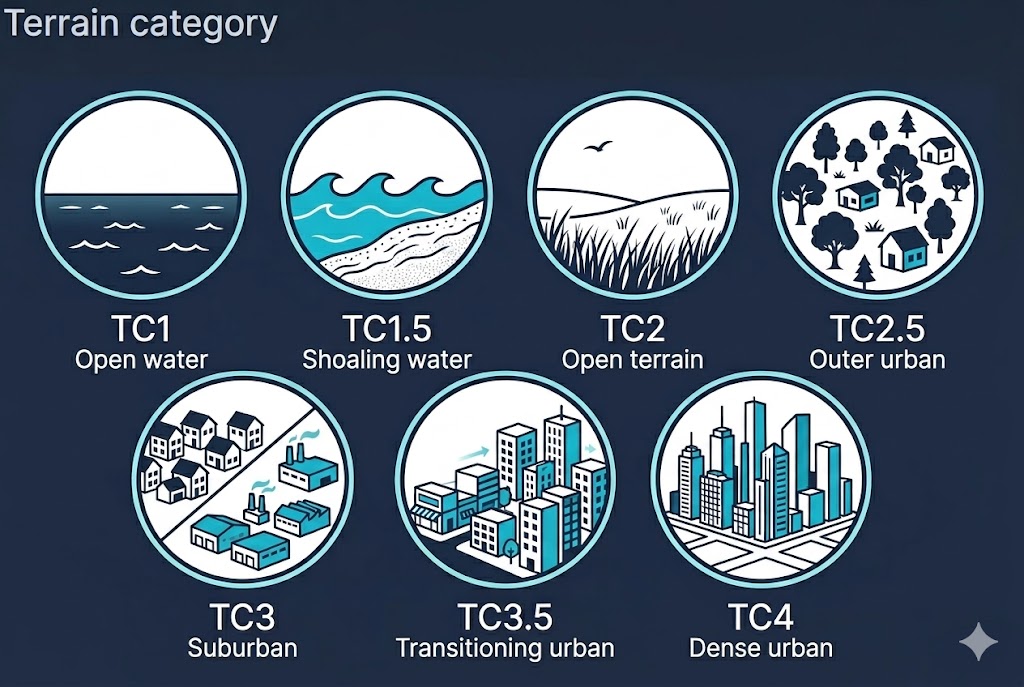
Enter the site address, building height and terrain category.
What this tool does
AS 4654.2:2012 sets the minimum vertical upstand for external waterproofing membranes at deck-to-wall, roof-to-parapet and similar terminations. The required height is governed by the design wind speed at the site — the higher the ULS pressure on the membrane edge, the higher the upstand needs to be to keep wind-driven rain from getting behind it.
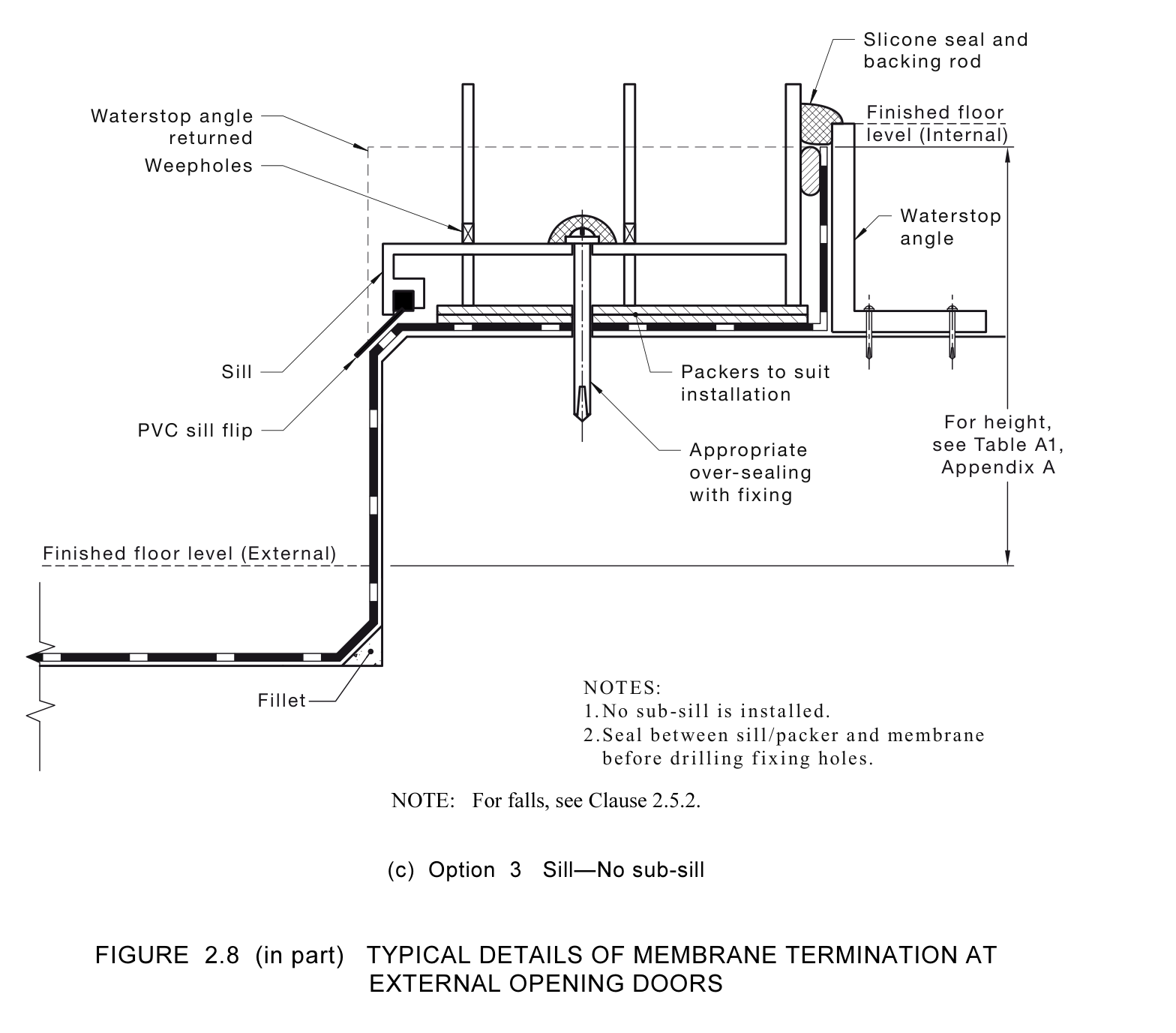
This tool takes an Australian address, picks up the wind region from the coordinates, and combines it with the building height and terrain category to give you the site ULS wind speed (Vh,u) and the matching termination band from AS 4654.2 Table A1. The number it returns is the vertical upstand — how far the membrane must turn up above finished floor level at a door sill, deck-to-wall or similar termination, as shown below.
AS 4654.2 Table A1 Bands
The full mapping of AS 4055 wind class to required termination height. The calculator above highlights the active band based on your inputs.
| AS 4055 class | ULS Vh,u (m/s) | Termination height (mm) |
|---|---|---|
| N1 | ≤ 34 | 40 |
| N2 | ≤ 40 | 50 |
| N3 / C1 | ≤ 50 | 70 |
| N4 / C2 | ≤ 61 | 100 |
| N5 / C3 | ≤ 74 | 150 |
| N6 / C4 | ≤ 86 | 180 |
| > N6 / C4 | > 86 | Consult engineer |
How the Calculation Works
The site ULS wind speed at the building roof height is computed from AS/NZS 1170.2:2021 as:
Vh,u = VR,500 × Md × Mz,cat(TC, h) × Ms × Mt × Mc
- VR,500 — 500-year return-period regional wind speed (Table 3.1), based on the auto-detected wind region.
- Md = 1.0 — worst-direction (no direction reduction). Conservative for a single termination-height number.
- Mz,cat — terrain/height multiplier (Table 4.1), interpolated between standard heights for the chosen TC.
- Ms = Mt = 1.0 — no shielding or topographic benefit assumed.
- Mc — climate change multiplier per Table 3.3 (1.05 for B2/C/D, 1.00 elsewhere).
- Importance Level 2 — 500-year ARI, standard for habitable buildings.
The resulting Vh,u is then matched against AS 4654.2 Table A1 to give the minimum termination height.
Why This Matters
The default 150 mm upstand widely used as a "rule of thumb" is the N5/C3 band — appropriate for severe wind environments, but often over-specified for inner-suburban Sydney where N2 or N3 conditions are typical. Conversely, sites in coastal cyclonic regions (C/D) can require upstands greater than 150 mm, and a default of 150 mm would be under-specified.
The key point is that a default 150 mm should not be carried blindly onto a drawing. The upstand should be re-derived per project against the site Vh,u — the calculator above is the quickest way to do that.
Scope and Limits
- External upstands only. Internal terminations in wet areas are governed by AS 3740 (≥ 150 mm above FFL), independent of wind speed.
- Preliminary estimate. Worst-direction Md, no shielding, no topographic factor. For final design, run a directional AS/NZS 1170.2 assessment with project-specific shielding (Ms) and topography (Mt).
- Houses (Class 1/10) can also be classified directly via AS 4055 — the bands above are framed in those terms for cross-reference.
Need a project-specific AS/NZS 1170.2 assessment with directional, shielding and topographic factors? Contact our facade and waterproofing engineers.