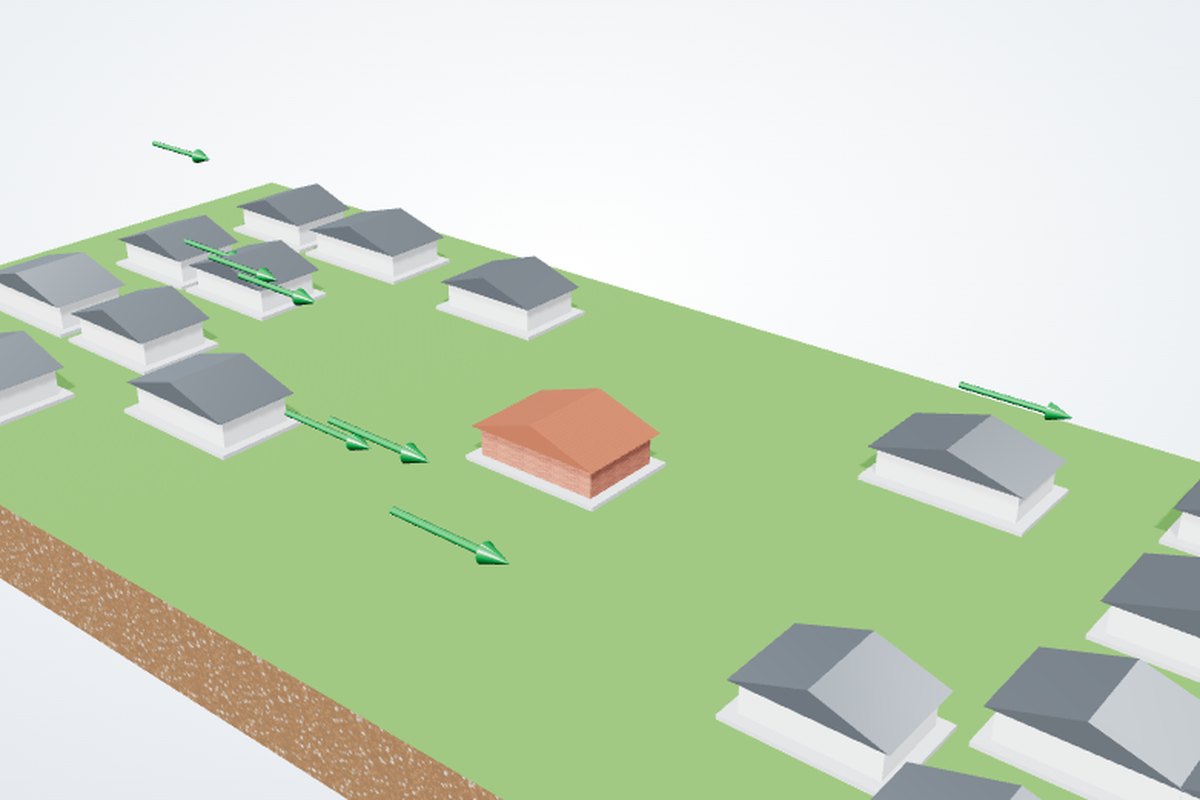
What the wind classification is for
Every house in Australia is built to a wind class. Trusses, tie-downs, cladding, windows, garage doors and roofing are all sold and certified against it, and the class is written on the plans and the truss certificate. AS 4055:2021 Wind loads for housing is the simplified version of AS/NZS 1170.2 for houses and similar buildings: up to 8.5 m high, 16 m wide and 35 degrees of roof pitch. It replaces the full directional wind speed calculation with ten site classes, N1 to N6 for the non-cyclonic regions and C1 to C4 for the cyclonic coast.
The class is a property of the site, not the house. Two identical houses on the same street can be different classes if one sits on the ridge and the other in the gully, or if one faces a park. That is why this calculator starts with the address and the shape of the land.
How the calculator reads the standard
AS 4055 Clause 2.2 picks the class from Table 2.2 using four things about the site:
- Wind region A, B, C or D from Figure 2.2. Sydney, Melbourne, Perth, Adelaide, Hobart and Canberra are Region A. Brisbane, the Gold Coast and the band inland of the cyclonic coast are Region B. The coast north of about 25°S is Region C within 50 km of the sea, and the north-west coast of Western Australia is Region D. In Regions C and D the class also depends on the distance from the smoothed coastline, in bands out to 50 km.
- Terrain category TC1 to TC3 from Clause 2.3: open water or flat treeless plains (TC1), farmland with scattered obstructions (TC2), developing outer suburbs (TC2.5) and established suburbs or industrial estates with at least ten house-size obstructions per hectare (TC3). It is the roughest terrain within 500 m in any direction, assessed as it will be five years after construction. Roads, rivers and parks under 250,000 m² inside a suburb still count as TC3.
- Topographic class T0 to T5 from Table 2.4. Three things matter: the steepest slope in the top half of the hill, the height of the hill, and whether the house sits in the lower, middle or top third of it. Flat ground and anything under 1 in 20 is T0. The top third of a 1 in 5 slope on a hill over 30 m high is T4. The calculator estimates all three from elevation data along eight compass lines through the address, and you can override it.
- Shielding FS, PS or NS from Clause 2.5. Full shielding needs at least two rows of houses in every direction and no open area within 100 m; partial shielding needs about 2.5 houses per hectare, which is acreage-type development or the second row back from a park. A house that fronts parkland, water or an airfield has no shielding. The standard also caps shielding by slope: full shielding only on T0 to T2, partial only up to T3, and the calculator applies that cap for you.
What the class means in numbers
| Class | Vh,s serviceability | Vh,u ultimate | Where it turns up |
|---|---|---|---|
| N1 | 26 m/s | 34 m/s | Sheltered suburban sites in Region A |
| N2 | 26 m/s | 40 m/s | Most of suburban Sydney, Melbourne and Adelaide |
| N3 / C1 | 32 m/s | 50 m/s | Exposed, elevated or coastal sites; sheltered cyclonic sites |
| N4 / C2 | 39 m/s | 61 m/s | Ridge tops, open country in Region B, cyclonic suburbs |
| N5 / C3 | 47 m/s | 74 m/s | Escarpments, exposed Region B coast, cyclonic coast |
| N6 / C4 | 55 m/s | 86 m/s | Severe exposure; most of the open cyclonic coast |
The gust speeds come from AS 4055 Table 2.1. An N class and a C class with the same speed are not interchangeable: the cyclonic classes carry higher internal pressures and a fatigue loading for the roof fixings, which is why C3 cladding and fasteners are different products from N5 ones.
Why waterproofing engineers care about the wind class
Wind-driven rain is what gets past a flashing or over a membrane upstand. AS 4654.2 ties the minimum vertical upward termination height of an external membrane to the wind class: 40 mm for N1, 50 mm for N2, 70 mm for N3 and C1, 100 mm for N4 and C2, 150 mm for N5 and C3 and 180 mm for N6 and C4. The calculator shows that height with the class, and our termination height calculator works it the other way round from a full AS/NZS 1170.2 site speed. The class also sets the design pressure on facade panels, balustrades and windows, and the uplift on roof membranes and their mechanical fixings.
When the simple method is not enough
AS 4055 stops at 8.5 m high and 16 m wide, at roof pitches above 35 degrees, and wherever Table 2.2 shows NA, which happens on the steep, exposed parts of the cyclonic coast. Apartment buildings, commercial buildings, anything on a cliff edge, and any house where a certifier questions the terrain or shielding call go to AS/NZS 1170.2, where the wind speed is calculated by direction with the terrain, shielding and topographic multipliers worked out properly. That is what an Excelo wind assessment does, and the report is what the truss manufacturer, the facade contractor and the certifier sign off against.
Questions we get asked
What wind class is Sydney?
Sydney is in Region A. A typical suburban site (terrain category 3, flat ground, partial shielding) is N1, while an exposed, unshielded or elevated site is N2 or N3. Ridge-top and coastal sites can reach N4. The class is site specific, so check the terrain, slope and shielding rather than assuming N2.
What is the difference between N and C wind classes?
N classes (N1 to N6) apply in the non-cyclonic Regions A and B. C classes (C1 to C4) apply in the cyclonic Regions C and D, where the same gust speed is paired with higher pressures and the fatigue loading of a cyclone, so C3 is not the same as N5 even though both are 74 m/s.
What are the design wind speeds for each class?
AS 4055 Table 2.1 gives ultimate gust speeds of 34 m/s (N1), 40 (N2), 50 (N3 and C1), 61 (N4 and C2), 74 (N5 and C3) and 86 m/s (N6 and C4), with serviceability speeds of 26, 26, 32, 39, 47 and 55 m/s.
How does the slope of the site change the wind class?
AS 4055 Table 2.4 gives a topographic class T0 to T5 from the steepest slope in the top half of the hill, the height of the hill and whether the house sits in the lower, middle or top third. A house on the top third of a 1 in 5 slope is T3 or T4, which typically lifts the wind class by one or two steps.
Does AS 4055 apply to my building?
AS 4055 covers houses and similar buildings up to 8.5 m high and 16 m wide with roof pitches up to 35 degrees. Taller or wider buildings, and any site the table marks NA, are designed to AS/NZS 1170.2 instead.