Pitting and Corrosion of Aluminium Sliding Door Sub-Sills: Causes and the Fix
What Is Sub-Sill Corrosion?
The sub-sill is the aluminium tray that sits under a sliding door or window frame on a balcony, terrace or podium threshold. Its job is to catch the water that gets past the door track and the frame, hold it, and drain it back outside through weep slots. Because it is buried under the frame, bedded on the slab or hob and packed against the tiles and screed, nobody sees it from the day the door goes in until the day the ceiling below starts to stain.
Aluminium is normally protected by a thin, self-healing oxide film. That film survives neutral water and air indefinitely, which is why aluminium windows last. It does not survive three things the sub-sill is routinely exposed to: wet cement, dissimilar metals and standing salty water. When the film is attacked locally, the metal underneath corrodes in small deep pits rather than evenly, and a 2 mm tray can be holed in a few years while the exposed face of the frame still looks fine.
How to Recognise It
- White, chalky or crusted deposits (aluminium hydroxide) along the sill, in the track, at the ends of the sub-sill or at the weep slots. On a powder-coated sill the coating blisters or lifts in patches with white powder underneath.
- Pinholes and pits in the tray when the door track is lifted or an end cap removed: small craters with a rough grey-white floor, sometimes through the full thickness.
- Staining or drip marks on the slab soffit or the ceiling of the unit below, directly under the door line, after rain. Often the first symptom anyone notices.
- Water sitting in the sub-sill after rain instead of draining, or weeping out at the ends rather than through the slots.
- Mortar, screed or render packed hard against the back and ends of the sill, with the corrosion worst exactly where the cement touches the aluminium.
- Rust bleed at the fixings or the brackets that hold the sill or the balustrade next to it: a sign that incompatible metals are in contact.
The exposed frame can be perfect. The damage is on the underside and ends of the tray, where it sits in cement and water.
Case Study: Door Sills Bedded Straight Onto the Screed
These photos are from the balconies of a 13-storey apartment building in Sydney, taken before the remedial works started. The sliding door frames looked sound from inside the unit. At the front edge of the sill, where the aluminium meets the tiles, the metal has corroded right through.
The cause: alkali from wet screed in direct contact with the aluminium. Nothing else on this sill was needed to do this damage.
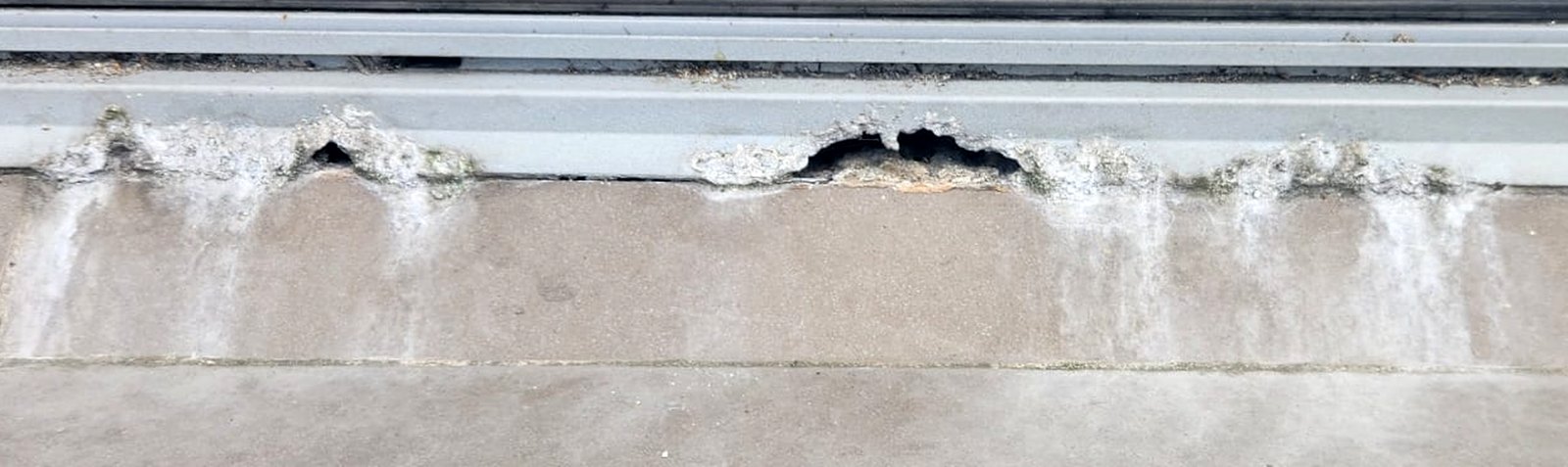
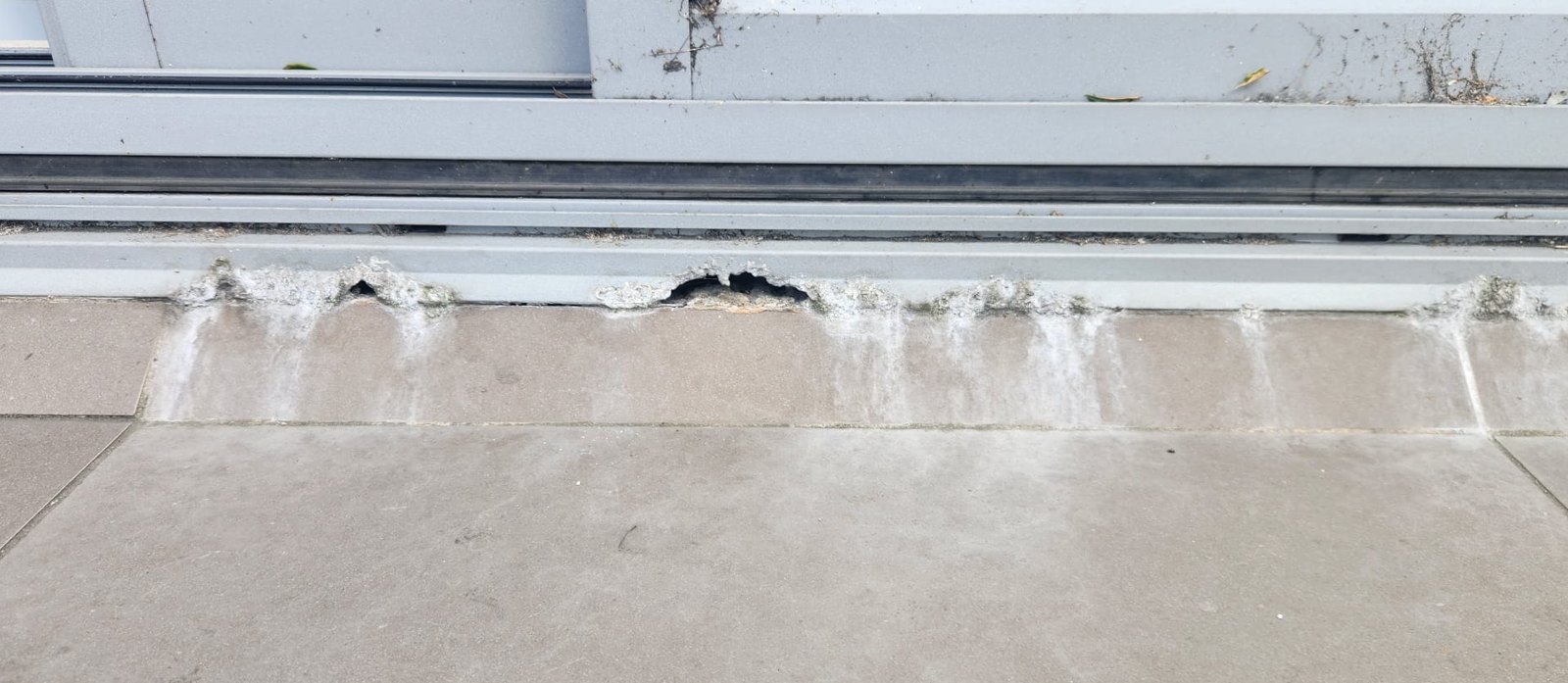
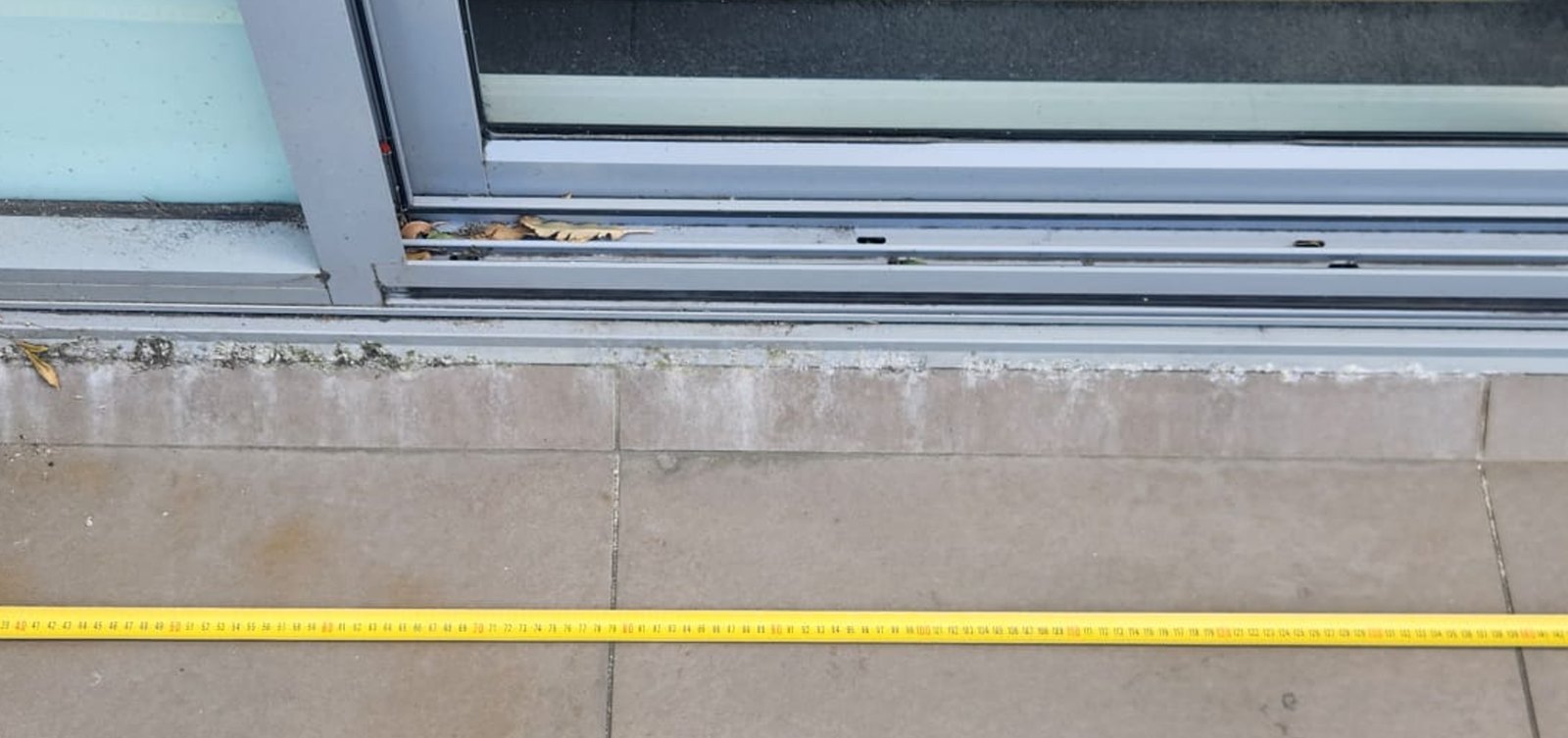
What happened. The sills had been bedded directly onto the cement screed, with no membrane between the screed and the aluminium. Wet screed is strongly alkaline, at around pH 12.5 to 13.5. The thin oxide film that protects aluminium is only stable close to neutral, so in that environment it dissolves and the metal underneath starts to corrode.
Why it pits instead of wearing evenly. The balconies had poor falls, so the bed under the sill got wet with every rain and stayed wet. Each wetting carried fresh alkali back to the metal. Powder coat protected the visible faces but not the underside, the cut ends and the fixing holes sitting in the mortar. The attack concentrated at those weak points, became pits and then went right through.
What the white crust tells you. White deposits running from under a sill are not just efflorescence from the tile grout. Here they are hydrated alumina and lime salts carried out of the bed by water draining through the corroded metal. Seeing them along a door line is a sign that the sill is sitting in cement and is already corroding.
The fix on this building. The doors come out. The screed is cut back from the door line so a clearance is provided between the screed and the new sub-sill. The membrane is turned up in front of the sub-sill against a waterstop angle, and the clearance is closed with backing rod and sealant, never filled with mortar. The balcony is re-screeded to fall away from the door, re-waterproofed and flood tested before tiling. No bare aluminium is left touching cement. Sealing over the holes would not have helped, because the metal under the sealant would keep corroding while the bed stayed wet.
The rule that comes out of this job is simple: screed and aluminium should never be in contact. Provide a clearance between them, and keep it sealed, not packed.
What Causes It
- Alkali attack from cement. Wet mortar, screed, render and tile adhesive are strongly alkaline (pH above 12). Fresh cement dissolves the aluminium oxide film and etches the metal; every time the screed gets wet again the attack restarts. Sub-sills bedded straight onto mortar, or with the screed and tile bed packed against their back, pit from the cement side in. This is the most common cause on balconies and it is entirely a detailing failure.
- Bimetallic (galvanic) corrosion. Aluminium in wet contact with stainless steel, copper, brass or bare steel becomes the sacrificial metal. Stainless screws through the sill, a copper pipe or brass fitting touching it, steel balustrade brackets fixed through it, or steel lintels and angles under it will all drive pitting at the contact. Copper-bearing run-off from a roof or a tap is enough.
- Chlorides. Within a few kilometres of the coast, salt-laden air and spray deposits chlorides on every horizontal surface. Chlorides break down the oxide film at weak points and sustain deep pits. A sill that holds water and is never washed concentrates them.
- Trapped water. Sub-sills are meant to drain. When the weep slots are blocked by debris, sealant or the tiler's grout, when the end dams are missing so water runs along the sill into the wall, or when the sill was installed level or back-falling, the tray holds a permanent puddle. Wet, oxygen-starved contact under debris ("poultice corrosion") pits aluminium fastest of all.
- Damaged protection. Anodising or powder coat cut through at drilled holes, saw cuts, end dams and fixings leaves bare metal at exactly the places that stay wet. Field-cut sills are almost never re-sealed.
- Incompatible sealants and packers. Acid-cure silicones and some bituminous products attack aluminium; so do packers that hold water against it.
How Serious Is It?
A pitted sub-sill is a waterproofing failure first and a structural question second.
- Leaks to the unit below. Once the tray is holed, the water it was designed to catch goes straight down into the slab, the wall cavity or the ceiling below. The pattern is a leak under the door line that appears after rain, which owners corporations commonly chase through the balcony membrane first.
- Hidden damage spreads. The water that escapes the sill feeds corrosion of steel lintels, angles and balustrade fixings, rots timber framing, and keeps the slab edge saturated, which drives concrete spalling.
- It is not fixable by sealant. A holed tray cannot be caulked from above; the corrosion continues under the sealant and the water finds the next pit.
- Structural fixings. Where the balustrade posts are fixed through or beside the sill, the same wet, dissimilar-metal environment is attacking the fixings that hold the balustrade. Those need checking at the same time.
The Remedial Fix
- Confirm the entry point. Stage the water testing so the door, the sub-sill and the membrane upturn are tested one at a time, and open the sill ends or lift a track section to inspect the tray. Do not strip the balcony membrane on the assumption that it is the membrane.
- Replace, do not patch, a pitted sill. Remove the door panels, lift the frame and remove the sub-sill. A new sub-sill (aluminium, or stainless steel where the exposure warrants it) with welded or sealed end dams and clear weep slots, set on a proper fall to the outside.
- Isolate the aluminium from the cement. The new sill bears on a membrane or a compatible bedding, never on raw mortar. The screed and tile bed stop short of the sill with a sealed, flexible gap; the membrane is dressed up and sealed to the back of the sill, not the sill bedded into the screed.
- Break the metal couples. Fixings in a compatible grade with isolating washers and sleeves; no copper, brass or bare steel in contact with the sill; balustrade brackets isolated with nylon or EPDM packers and their own flashing.
- Re-establish the drainage path. Weep slots open and above the external finished level, end dams turned up, the sill falling out, nothing sealed that was meant to drain. Where the sill sits behind a hob or a drained threshold, the hob drainage must be reinstated too.
- Protect field cuts. Every cut edge, drilled hole and end dam sealed with a compatible sealant before installation; powder coat touched up where it is breached.
- Check the neighbours. The same conditions usually exist at every door on the elevation. One holed sill is a sample, not an exception.
The sub-sill detail in our library (external door sill with sub-sill, drawn on a separate-pour kerb with a hydrophilic waterstop and the membrane carried under the sill) is the arrangement that avoids all four causes.
When to Involve an Engineer
- A leak under a balcony door that has already had the membrane or the sealant "fixed" once.
- Any pitting found on sills in a building less than fifteen years old, or on more than one door: the cause is systemic and the remediation needs a scope across the elevation, not a door at a time.
- Where the balustrade is fixed through or next to the affected sill, so the fixings are assessed with it.
- Strata buildings, where an independent cause report, a specification and a warrantable detail are needed before a contractor is engaged, and in NSW where the remedial waterproofing is a declared design under the DBP Act for Class 2 buildings.
Frequently Asked Questions
The frame looks perfect. How can the sill be corroded?
The frame sits in air; the sub-sill sits in wet cement and standing water, often against dissimilar metal. Aluminium pits where its oxide film is attacked, and that happens on the hidden underside and ends of the tray, not on the visible face.
Can we just reseal the sill?
No. Sealant over a holed tray fails at the next pit, and the corrosion continues under it. The sill has to come out, and the detail that corroded it has to change.
Is it the balcony membrane?
Sometimes, but a leak confined to the door line after rain, with staining directly below the sill, points to the sill first. Staged water testing settles it in an hour; stripping the balcony to find out costs weeks.
Why do coastal buildings get this so much worse?
Chlorides from salt air concentrate in any sill that holds water, and they are the most aggressive thing an aluminium oxide film meets. The same detail that survives inland for decades can perforate near the coast in a few years.
Should the new sub-sill be stainless steel?
In severe coastal exposure, or where the sill cannot be fully isolated from cement and other metals, a 316 stainless sub-sill removes the pitting mechanism. Elsewhere a correctly isolated and drained aluminium sill is fine; the detail matters more than the metal.
Leak under a balcony door that has already been "sealed"? Contact our waterproofing and remedial engineers for staged water testing, a cause report and a warrantable sub-sill detail. Related: the cavity sliding door waterstop detail and our Specification 26 checker.