Why Australian basements are designed to a British Standard
Australia has no standard for basement waterproofing membranes. AS 3740 covers wet areas inside a building and AS 4654 covers membranes above ground, but neither says how to keep ground water out of a structure below ground. The NCC asks for a result (no water penetrating into the building) and leaves the method open. So Australian engineers, certifiers and waterproofers use BS 8102:2022, Protection of below ground structures against water ingress, as the reference, and a basement waterproofing design or Performance Solution in NSW will usually cite it.
This calculator follows the BS 8102 decision path so you can see, before you brief a waterproofer or sign a contract, what grade of protection the space needs and which system type (A, B, C or a combination) is appropriate for the water table on your site.
How the calculator works
BS 8102:2022 makes two decisions first: the grade of performance the space needs, from its intended use (Table 2), and the water table classification from the geotechnical report (Clause 5.1.3). Table 1 then sets which protection types are acceptable for that water table, and Clause 6.2.3 calls for combined protection where the risk, or the consequence of failure, is high.
| Grade | Performance (BS 8102 Table 2) | Typical use |
|---|---|---|
| 1a | Seepage and damp areas tolerable where they don't affect the use; internal drainage might be needed | Car parks, plant areas |
| 1b | No seepage; damp areas tolerable | Car parks, general stores |
| 2 | No seepage; damp only from internal condensation; vapour may need managing | Plant rooms with electrical equipment, workshops |
| 3 | No water ingress or damp; ventilation, dehumidification or air conditioning needed | Habitable rooms, offices, archives |
Type A, Type B and Type C protection
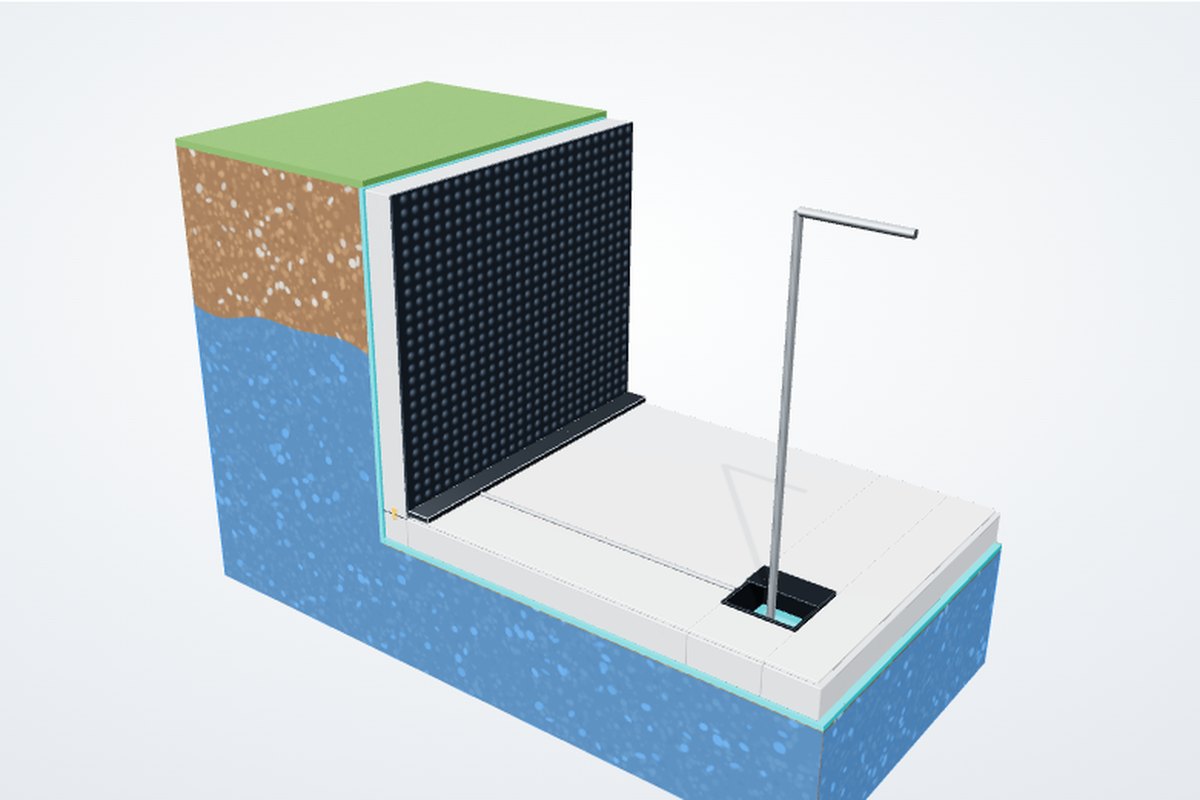
Type A (barrier) is a membrane bonded to the structure. On a boundary wall it has to be pre-applied against the shoring. Type B (structurally integral) is reinforced concrete designed to resist water, with waterstops at every joint and often a crystalline admixture. Type C (drained) lets water reach a cavity drain membrane on the inside face, then channels it to a sump and pumps it away, so it relies on maintained pumps and an outlet.
Why an unknown water table is treated as high
The water table classification comes from the geotechnical report and nowhere else. Until one is available we design for High, the conservative case. Where the water table is High, the base of the slab must be waterproofed too, not just the walls, and uplift goes to the structural engineer.
What this means for a NSW design declaration
Under the Design and Building Practitioners Act, waterproofing of a Class 2 building is a regulated design. A basement that leaks is the most expensive waterproofing defect to fix, because the membrane is behind the structure. Getting the grade, the water table and the system type agreed at concept stage is what keeps the declared design honest and the strata scheme out of the tribunal later.
Questions we get asked
Is there an Australian Standard for basement waterproofing?
No. AS 3740 covers internal wet areas and AS 4654 covers external above-ground membranes. Nothing in the Australian suite sets out how to keep ground water out of a below-ground structure, so Australian designers use BS 8102:2022 as the reference and cite it in Performance Solutions and design declarations.
Can blockwork be Type B?
No. Type B relies on the concrete itself being water-resisting, with waterstops at every joint. Blockwork has a joint every 400 mm, so it needs a Type A barrier or a Type C drained cavity. Core-filled H-blocks do let a hydrophilic waterstop run continuously through the grout core along the kicker joint, which improves the base joint, but the wall still isn't Type B.
What if I don't have a geotechnical report yet?
Design for a High water table, the conservative case, and make the measured water table a hold point before the slab is poured. That is also when the question of waterproofing under the slab gets answered.
Does a drained cavity (Type C) need power?
Yes. The sump pump needs a maintained power supply, usually with a battery backup and a high-level alarm, and the discharge needs a lawful point of connection. If that can't be maintained, Type C is off the table.